Important 2026 Dates:
Key Election Dates & Deadlines (November 2026)
| Event / Deadline | Date | Notes |
| Voter Registration Deadline | Monday, October 5, 2026 | Applications must be postmarked or delivered in person by this date. |
| First Day of Early Voting | Monday, October 19, 2026 | In-person voting opens at designated Galveston County early voting locations. |
| Mail-In Ballot Application Deadline | Friday, October 23, 2026 | Applications must be received by the county clerk, not just postmarked. |
| Last Day of Early Voting | Friday, October 30, 2026 | Final day to vote before Election Day. |
| General Election Day | Tuesday, November 3, 2026 | Polls are open from 7:00 AM to 7:00 PM. |
Election Day: November 3rd
Galveston County Specific Logistics
Voter Registration Details
In Galveston County, voter registration is managed by the County Tax Assessor-Collector’s office.
-
The Rule: Voter registration applications must be physically signed. Digital or electronic signatures are not accepted by Texas law.
-
Submission: Applications can be hand-delivered to any Galveston County Tax Office branch (Galveston, League City, Santa Fe, or Texas City) or mailed to:
Galveston County Voter Registrar >
P.O. Box 1169
Galveston, TX 77553-1169
Voting In-Person (Countywide Polling)
Galveston County participates in the Countywide Polling Place Program. This means registered voters in Galveston are not restricted to a single assigned neighborhood precinct. During both Early Voting and on Election Day, voters can cast their ballot at any official vote center setup across the county (e.g., the Galveston County Courthouse, Joe Faggard Community Center in Crystal Beach, etc.).
Election Day: November 3rd
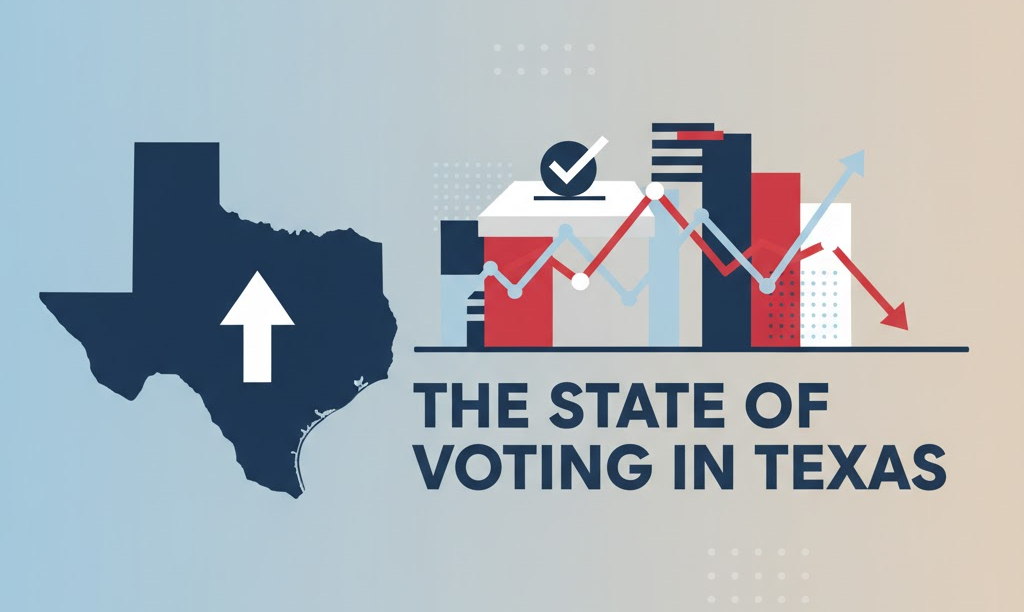
The State of Voting in Texas
Texas has some of the most restrictive voting laws of all fifty states, from voter registration to narrow rules for mail-in ballots to decreasing polling locations.
In Texas, one of the States with the maximum waiting period, voters must be registered 30 days before an election to be able to vote in that election. In addition, young voters face several obstacles to voting under Texas’ strict voting laws. Student IDs are not an acceptable form of required identification and many colleges also lack on-campus voting locations, partially due to a 2019 state law prohibiting temporary voting sites during the 12 days of early voting. (Texas Tribune 8/12/2024).
Mail-in ballots are restricted to seniors and disabled or sick individuals who can not make it to the polls unaided; pregnant women with a due date within 3 weeks before and after Election Day; those who are in jail, but not convicted of a felony and who are not able to make it to the polls; or those who will be out of the area during early voting thru election day. If you will be out of the area before sample ballots are available, you will need to apply to your County Election Office.
Application for mail-in ballots can be made anytime after January 1st of the election year, and must be renewed every year. Ballots must be received at least 11 working days before an election and must be renewed every year. Assisting Seniors and disabled persons to apply for mail-in ballots is confusing and risky to the volunteer deputy registrar (VDR), making it less likely that they will be available to help these vulnerable citizens to get their ballots counted. According to a Brennan Center report, “Study Reveals the Lasting Voter Suppression Effects of Restrictive Texas Law,”…thousands of mail ballot applications and mail ballots were rejected during the 2022 primary due to 2021 Senate Bill 1 and that nonwhite voters were disproportionately impacted…“The state enacted Senate Bill 1 in 2021, ostensibly to reduce widespread voter fraud — which in reality does not exist. The law made casting a ballot by mail more difficult, and it ended practices adopted during the Covid-19 pandemic to make voting easier, such as 24-hour and drive-thru voting.”
While S.B.1 is one of many antidemocracy laws enacted by 19 states in the year after the 2020 election, “it stands out for its sheer number of restrictive and discriminatory provisions, [in Texas] which largely target Latino and Black voters”. The Brennan Center, Sept 17, 2023.
Texas is one of five states that require that their voter registrars must be deputized to assist with voter registration. This involves a required training in the do’s and don’ts of registering voters and stiff penalties for violations.
Not surprisingly, decreasing polling locations leads to a decrease in voter turnout according to the Texas Tribune, Nov 6, 2024 “Texas voter turnout falls in 2024 election despite record registration numbers…A historic 18.6 million Texans were registered to vote in the 2024 election, and 61% cast ballots, a nearly 6% drop from the 2020 presidential race.
And finally The controversial recent midcycle re-districting by Governor Abbott this year has further implications for voter suppression in Texas, by diluting voting power among Latino and Black communities and also serious implications for the Country as a whole, as more States consider midcycle re-districting